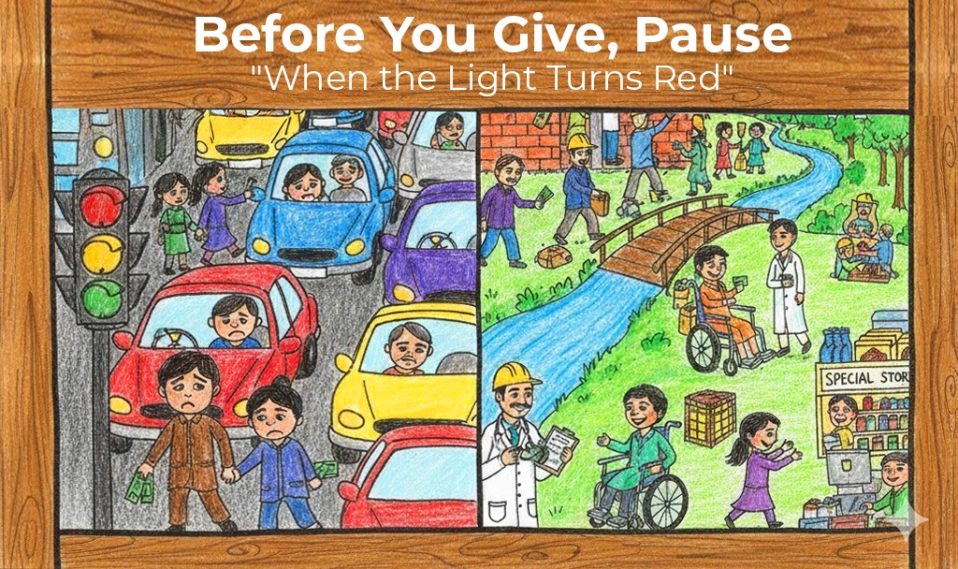
When the Light Turns Red
The light turns red. You stop.
But that’s when they start moving. From every corner, they rush in with tiny feet, tired faces, tapping on windows, weaving through metal and fumes. They come with well wishes for you on their lips, but not for free.
Prayers, meant to rise from the heart, are exchanged for a few rupees. And somehow, that feels okay.
If you’ve visited any major city in Pakistan, you’ve seen this at almost every intersection.
But what happens when kindness feeds a system built on desperation?
Because that’s what we’re doing. It makes us feel better. We think we’ve helped. But that single act of charity comes at a cost. A hidden, heavy opportunity cost.
The True Cost of Quick Charity
We go about our day thinking we’ve done our part. But we’ve fed a system that keeps our deepest societal wounds open: illiteracy, child vulnerability, poverty, marginalization of people with disabilities, unemployment, high mortality, and a crumbling economy. An economy increasingly threatened by climate change, where floods wash away whatever little security people have left.
And none of these find sustainable solutions, because our attention and our resources are diverted elsewhere.
You might think your Rs. 20 doesn’t matter. But it does. It adds up.
A recent Gallup survey said this: 110 million Pakistanis give to beggars. 71% of them had done so just in the past week. The median amount given. Rs. 20 per interaction.
That adds up to Rs. 374 million a day, or Rs. 136 billion a year, which is nearly half a billion dollars.
That’s not nothing. That’s massive!
That’s money moving daily through an informal system that offers no accountability, no long-term support, and no real change. It’s money not going to hospitals. Not going to schools.Not going to real, replicable models that are making a difference. It is money diverted from solving our systemic issues, which keep exacerbating and multiplying and seeping insidiously into the fabric of society, making it impossible to change.
Why People Still Give
And even if people begin to understand, they’re faced with another challenge: information asymmetry.
There are over 18,000 active nonprofits in Pakistan—formal, informal, grassroots, and institutional. But most people don’t know where to start, or who to trust. So, they give where it’s most visible. To whoever’s at the window. To whoever’s feeding people. Because it’s familiar. And easy. And gives an instant sense of having done good.
But there are people doing the work. Quietly. Relentlessly.
Community-Driven Change
There’s a rural development initiative working in interior Sindh that runs a community needs-based program. They don’t claim to save anyone; they have no savior complex, but they are there working through partnerships and collaboration with the locals, building sturdy infrastructure with local materials, regional knowledge, and expertise. They don’t come with answers; they come with questions. Their employees and staff are all from the local regions that they work in, and they are there with the people, speaking their language and deciding on what is needed.
Access to Justice, Dignity Intact
Then there is an organization that is fighting people’s legal battles for them, bringing them justice when they cannot afford it. Domestic violence survivors, dispossessed women, and families displaced by land mafias are all protected through trained professionals and discreet lawyers working for them free of cost. The organization protects its clients’ identities and upholds their dignity even when the world refuses to treat them fairly or even as human.
Can you, as an individual, do that?
Good Intentions Aren’t Enough
You might have the intention, but not the infrastructure or the time. And that’s okay.
Many organizations are handing out food, but food is not the only problem. It’s just the most visible one. It’s the first thing that comes to mind when we think of charity, because it’s the simplest and most immediate form of relief.
But at the heart of real change is the belief that people already have strength, knowledge, and experience, and that sometimes, what makes the difference is someone walking alongside them as they regain stability.
When Giving Does Harm
Giving to beggars isn’t kindness. It’s a shortcut. One that’s enabled a massive, often criminal, underground economy. There are entire mafias making money off children sent out to beg. These children are vulnerable, usually mutilated, and trafficked because it pays.
The business model works when we roll down the window and give.
The estimate is that more than 1.5 million children live on the streets in Pakistan. That’s not just a number. That’s a generation. And we’re failing them every day we feed a system that keeps them on the pavement.
What If We Gave Opportunity Instead?
What if we gave them a path forward instead of crumpled notes?
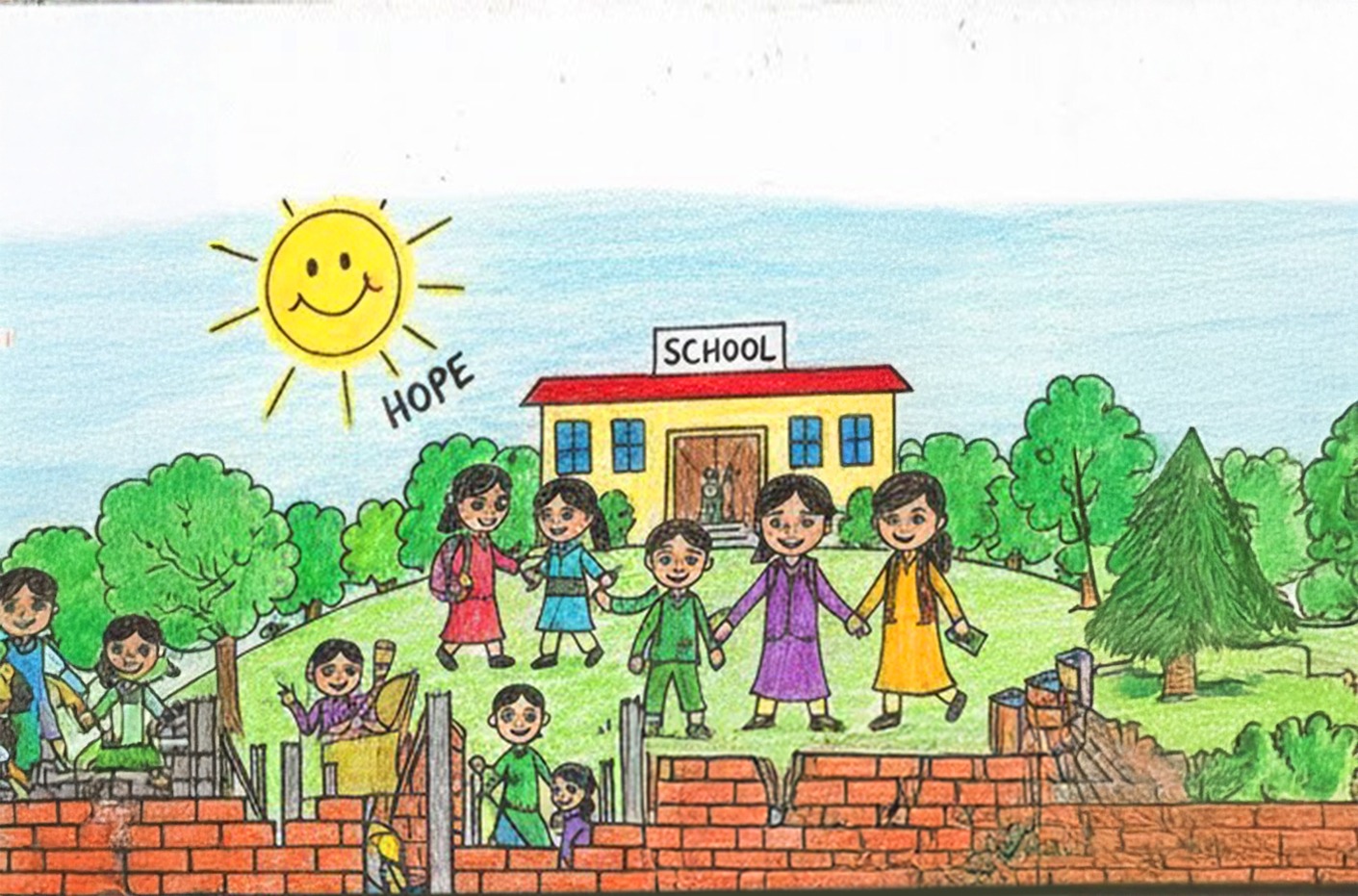
There are nonprofits doing this work. You can support them with what they need. And when you do, your donation stops being a transaction. It becomes a contribution that continues to grow, ripple, and benefit beyond your sight.
Help does not have to be money only. You can give time and attention, volunteer, or learn about the organization or a cause that appeals to you. You can teach your children to act on compassion, not just feel it.
Some organizations are working on a model of human dignity where they have special stores, and people in need are given cards to shop for rations rather than being made to run after handouts. Then there are organizations offering specialized healthcare in facilities that rival the best private hospitals and cancer hospitals designed so people don’t feel they are being treated as a favor.
There are some working in disability and inclusion. Many started with the desire to help, and when they spent time with people with disabilities, the founders of these organizations realized that money wasn’t the answer. Perception was. Families needed to see their children as capable. And the only way to change that was to help those children become truly independent.
So these organizations taught them skills. Not just embroidery and block printing, but digital tools, technical trades, and job readiness. They partnered with companies to find jobs. They helped people see disability not as a limitation, but as a lens.
We met a mother who said, “I never thought my child would be independent. Much less support us.” But now he does. There are kids learning martial arts. Representing Pakistan internationally, winning medals, and making us proud.
There Is a Way Forward
We are far from being an equitable society. But we’re not helpless. We can support the people doing the work. We can be part of the solution. And when we do, we stop feeling burnt out. Because we’re no longer stuck in despair, we’re moving forward.
All of these organizations have spent years on the ground. They’ve built trust. They understand the people they work with and do the best they can within the realities of their models.
There are over 150 such causes you can explore, where each addresses a different need, a different story.
And if you’re unsure where to begin, visit them. Speak to the people leading these initiatives. Or talk to us, as we’ve done the groundwork and seen the impact. We can help you find the cause that resonates with you, aligns with your values, and channels your giving into something lasting.
So pause before you give. Pause before you roll down the window.